
World Health Organization
Scaling innovations in public health systems: guidance and toolkit
Guide
30 Jan 2026
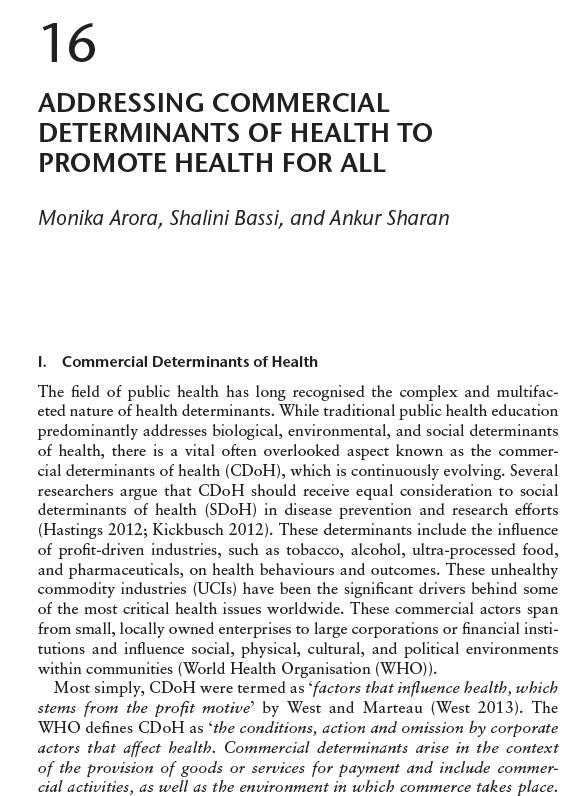
With a rise in non-communicable diseases (NCDs), public health researchers are increasingly focusing attention on risk factors like tobacco, alcohol, and unhealthy diet. The detrimental impact of the current economic system concerning commercial determinants of health (CDoH) is increasingly evident. The expanding influence of commercial actors, ranging from small, locally owned enterprises to large corporations or financial institutions, significantly shapes the social, physical, cultural, and political environments of communities, affecting individuals’ health and well-being. This chapter aims to comprehensively examine the impact of CDoH on public health globally and in the South-East Asia region (SEAR) with focus on India. It elucidates how corporations and their strategies influence health equity, health behaviours, health outcomes, and human development, thereby impacting the health and development outcomes of individuals and populations. The chapter further explains the mechanisms and policies needed to address these CDoH in India and globally. We conducted a literature review in a snowballing manner using a search strategy that employed keywords – ‘CDoH’, ‘India’, ‘SEAR’, ‘health behaviour’, ‘health equity’, ‘health development’, ‘health outcomes’, ‘corporate influence’, ‘consumer behaviour’, ‘tobacco’, ‘alcohol’, ‘ultra-processed foods’, etc. – and search strings to identify articles across various databases, including PubMed/Medline, Embase, Global Health, WHO Global Health Observatory, IndMED, Indian Citation Index, and other seminal reports. The search utilised Boolean operators to logically combine search terms, and used filters and screening based on relevance to refine the results. The review outlined the pathways and adverse impact of tobacco, alcohol, and ultra-processed foods – referred to as unhealthy commodity industries (UCIs) in exacerbating the global NCD burden, particularly in low- and middle-income countries (LMICs). Additionally, it underscores how CDoH exacerbate health inequities, especially among vulnerable population groups, and adversely impact the economy and development agenda of a country. Regulatory framework, evidence-based policy approaches, stakeholder activism, capacity-building, and other interventions are identified as important approaches for addressing these challenges. We also identified the research priorities and monitoring mechanisms to assess the impact of CDoH scientifically. The findings underscore the importance of a multifaceted approach to addressing CDoH. By strengthening regulatory mechanisms through multi-sectoral engagement, fostering multi-stakeholder engagement, advancing research on the legal landscape to address CDoH, and capacity-building initiatives for research, monitoring, healthcare professionals, and CSOs, to better comprehend, identify, measure, act, and monitor the effects of CDoH.
Guide
30 Jan 2026
Article
15 Dec 2025

Report
15 Nov 2025
Publication
31 Oct 2025

Report
20 Oct 2025